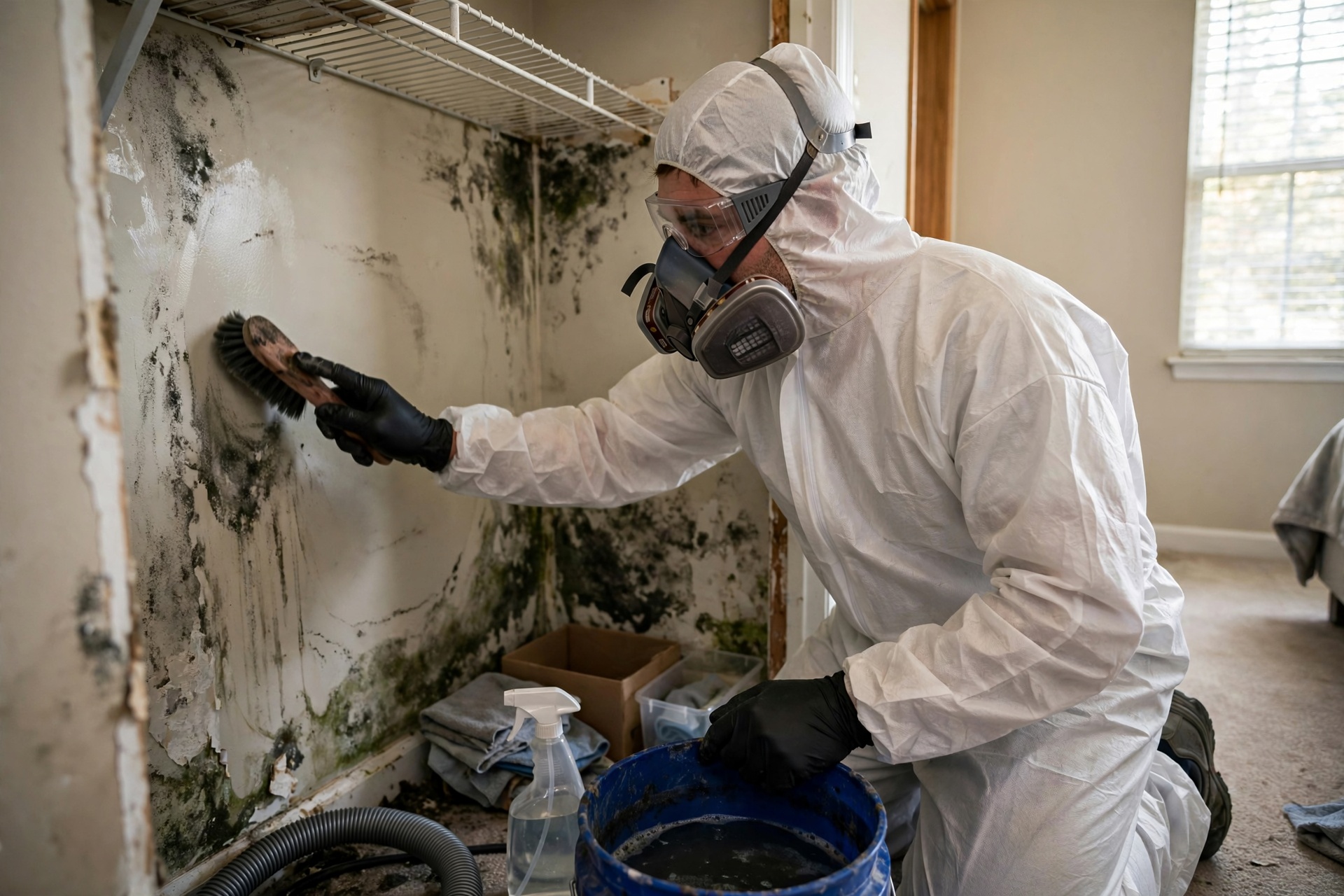
Closets in Wilson County homes often trap moisture because they sit against exterior walls with limited airflow, especially in Providence and Beckwith neighborhoods where many houses were built before modern vapor barriers became standard. Hot, humid summers push indoor humidity above 60 percent for weeks, allowing mold to colonize drywall, baseboards, and the back of shelving units. Technicians must pull carpet or flooring edges back to check for wicking along the slab edge, a step that frequently reveals growth that started from a single roof leak or condensation line.
When removing affected materials, crews use six-mil containment walls sealed to the ceiling to keep spores from drifting into bedrooms or living areas near Providence Marketplace. HEPA vacuums and negative-air machines run continuously during demolition because Mount Juliet's mild winters still allow slow moisture accumulation in unconditioned spaces. Antimicrobial rinses are applied only after all visible growth is gone; otherwise the product simply seals spores in place and the problem returns the next humid season.
Edge cases include cedar-lined closets where the wood itself holds moisture and requires full disassembly, and walk-in closets with HVAC returns that pull air across damp surfaces. Homeowners in Lebanon-facing sections of Mount Juliet sometimes see faster regrowth because prevailing winds carry more moisture through attic vents that connect directly to closet ceilings. Proper documentation of every removed section helps when insurance adjusters ask why the job extended beyond the visible patch.
Technician insight
In Mount Juliet the thing that catches most people out with closet mold removal is how quickly humidity from our long summers penetrates older homes in Beckwith and around Charlie Daniels Park, especially when closets share a wall with an uninsulated attic knee-wall that never gets checked.
Providence Walk-In Closet
A homeowner in Providence noticed a musty smell after a week of heavy rain. Inspection showed black growth on the back wall and baseboard where the closet met an exterior wall with poor flashing. Crews removed two sheets of drywall, treated the framing, and ran dehumidifiers for three days until readings dropped below 12 percent. The smell disappeared and no regrowth appeared the following summer.
Closet Mold Removal Services We Offer
✓Closet Containment Barrier Installation
Sealed six-mil plastic walls and negative air setup prevent spores from migrating into adjacent living spaces during removal.
✓Mold-Infested Drywall and Trim Removal
Cut out affected drywall, baseboards, and shelving to 18 inches beyond visible growth, then bag and remove all debris from the property.
✓HEPA Vacuuming and Air Scrubbing
Multiple passes with HEPA-filtered equipment followed by continuous air scrubbing to capture remaining airborne particles before reconstruction.
✓Antimicrobial Surface Treatment
Application of EPA-registered antimicrobial to cleaned framing and subfloor after all mold is physically removed.
✓Moisture Source Mapping
Thermal imaging and moisture meter readings to locate leaks, condensation points, or poor ventilation feeding the closet.
✓Post-Removal Dehumidification
Placement of commercial dehumidifiers and air movers until wood moisture content returns to acceptable levels for the Mount Juliet climate.
Closet Mold Removal Cost in Mount Juliet, TN
| Service | Typical Range | What Affects It |
|---|---|---|
| Small single closet | $350–$650 | Standard reach-in with surface growth only |
| Large walk-in closet | $700–$1,400 | Includes shelving disassembly and slab edge work |
| Hidden growth behind drywall | $900–$1,800 | Requires extended removal and drying time |
| Emergency after-hours response | $150–$300 | Added to base job when called outside normal hours |
Ranges are typical for Mount Juliet, TN and confirmed with an exact written quote before any work starts.
How it works
- 1
Initial Containment and Safety Setup
Technicians establish sealed barriers and negative air at the closet doorway before any disturbance begins.
- 2
Inspection and Material Removal
Visible mold and damp materials are cut out and bagged while moisture readings are recorded on framing and subfloor.
- 3
Cleaning and Antimicrobial Application
HEPA vacuuming and surface treatment follow, then equipment runs until air sampling confirms clearance.
- 4
Drying Verification and Documentation
Final moisture checks and photos are taken before barriers come down and the space is released for reconstruction.
Pricing
Most closet jobs fall into the mid-hundreds to low-thousands depending on size and hidden extent.