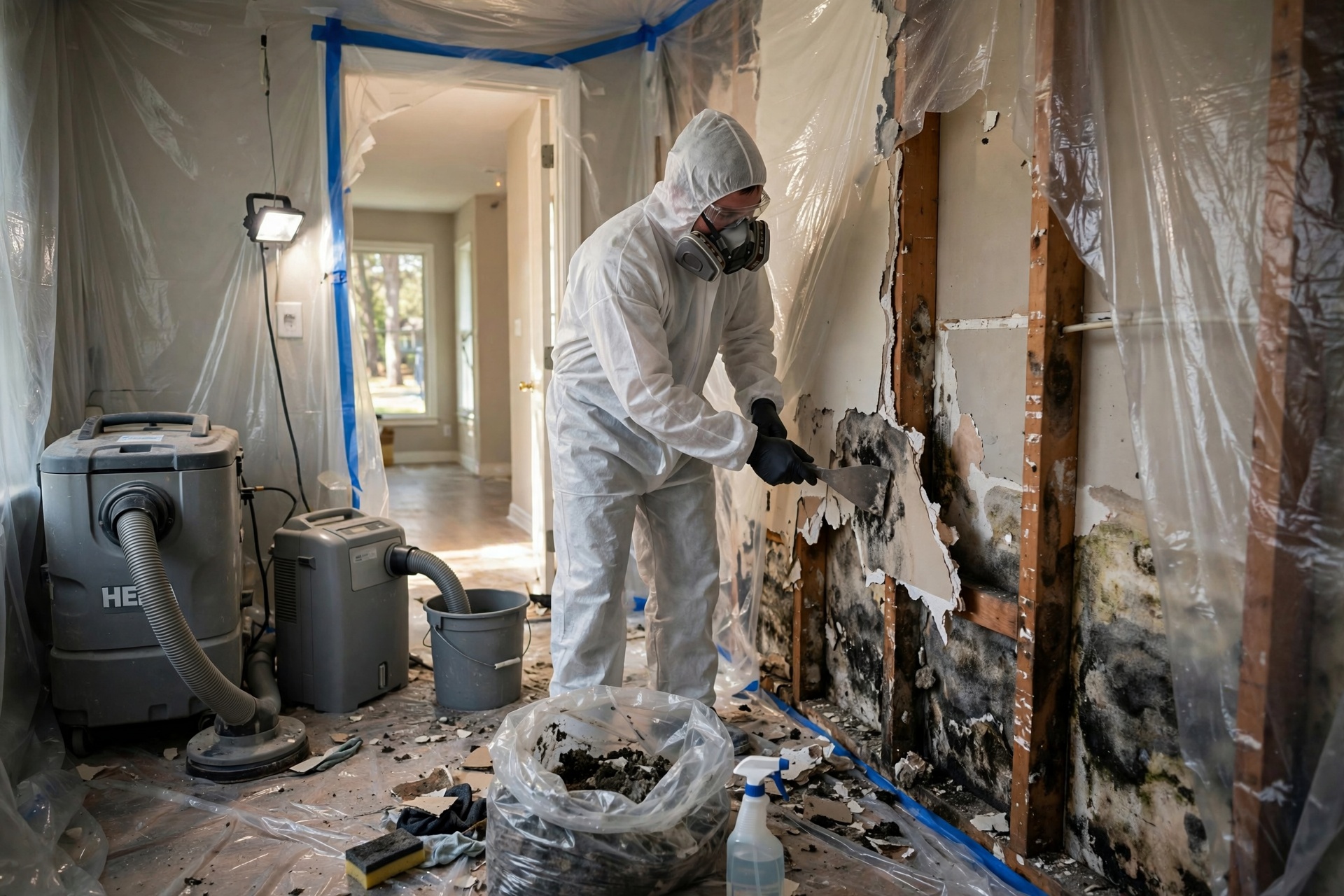
Wilson County homes near Providence Marketplace and Charlie Daniels Park often sit on clay-heavy soils that hold moisture after heavy rains, pushing water into crawl spaces and slab edges. When a pipe bursts or a roof leak hits during the humid subtropical summers, mold colonies can take hold behind baseboards and under vinyl flooring within 48 hours. Technicians must pull affected drywall at least 18 inches past visible growth and run negative-air machines to keep spores from drifting into unaffected rooms.
Beckwith neighborhood properties built in the 1990s frequently have HVAC ducts routed through unconditioned attics where condensation from mild winters meets summer humidity. Post-water events here require checking supply lines inside walls rather than just the obvious wet carpet. Containment barriers and HEPA filtration stay in place until air sampling shows spore counts match outdoor baselines from nearby Lebanon or Nashville.
After standing water from Wilson County storms, hidden mold often appears in insulation tucked between floor joists. Removing it means cutting access panels from below and replacing saturated batts with closed-cell foam in high-moisture zones. Homeowners in Providence see faster regrowth if dehumidifiers are pulled too soon, so equipment runs until wood moisture content reads below 12 percent.
Local codes in Mount Juliet require proper disposal of contaminated materials at approved Wilson County landfills. Skipping this step risks fines when neighbors report odors drifting from open dumpsters. Every job includes photo documentation of the containment setup and final clearance testing before any reconstruction begins.
Technician insight
In Mount Juliet, the thing that catches most people out with post-water-damage mold remediation is how quickly the humid subtropical air turns a small leak behind a Providence bathroom wall into growth that travels up into the attic. Older homes near Beckwith with original ductwork in unconditioned spaces often need the entire system isolated, or spores just recirculate after you finish the visible work.
Beckwith Home After Pipe Burst
A supply line under a Providence-area kitchen failed during a summer storm, soaking subfloor and lower cabinets. Inspection showed colonies already forming on joists and inside the nearby HVAC return. Crews contained the kitchen, removed saturated materials, treated framing, and ran drying equipment for four days until readings stabilized. Clearance samples matched outdoor baselines before cabinets were reinstalled.
Post-water-damage Mold Remediation Services We Offer
✓Crawl Space Mold Remediation After Plumbing Leaks
Removes colonies under Providence and Beckwith homes where slab leaks or sewer backups introduce moisture into dirt floors and joists.
✓Attic Mold Removal Following Roof Damage
Addresses growth in insulation and sheathing after storm leaks common near Charlie Daniels Park, including ventilation corrections to reduce future condensation.
✓Basement Wall Mold Treatment Post-Flooding
Treats concrete block and drywall in lower levels of Wilson County homes where groundwater enters during heavy subtropical rains.
✓HVAC Duct Mold Cleaning After Water Events
Cleans and sanitizes ductwork in homes around Providence Marketplace where condensation or roof leaks introduce mold into the air system.
✓Drywall and Insulation Replacement
Cuts out and replaces water-damaged materials behind baseboards and in ceilings once the source is stopped and drying is verified.
Post-water-damage Mold Remediation Cost in Mount Juliet, TN
| Service | Typical Range | What Affects It |
|---|---|---|
| Initial inspection and moisture mapping | $250–$450 | Larger homes or multiple rooms increase time on site |
| Crawl space remediation | $1,200–$2,800 | Depends on access difficulty and insulation replacement needs |
| Attic mold removal | $900–$2,400 | Higher when ventilation upgrades or sheathing work is needed |
| HVAC duct cleaning add-on | $600–$1,100 | Varies by number of runs and whether coils require separate treatment |
Ranges are typical for Mount Juliet, TN and confirmed with an exact written quote before any work starts.
How it works
- 1
Moisture Mapping And Containment
Technicians locate all wet materials with meters, then seal off affected zones with plastic barriers and negative air to prevent spore spread to the rest of the Mount Juliet home.
- 2
Removal Of Affected Materials
Cut away moldy drywall, carpet, and insulation at least 18 inches beyond visible growth, bagging debris for proper Wilson County landfill disposal.
- 3
Antimicrobial Application And Drying
Apply EPA-registered treatments to framing and run commercial dehumidifiers and air movers until wood and drywall read below 12 percent moisture.
- 4
Clearance Testing And Documentation
Perform air and surface sampling, then provide photos and reports showing the job meets pre-loss conditions before reconstruction starts.
Pricing
Cost depends on square footage affected, hidden damage discovered during inspection, and whether HVAC cleaning is required.